

EU freight compliance engine · España · Pilot for gestorías
Every trip's papers, checked and sealed.
From 5 October 2026 Spain's documento de control administrativo (DeCA) must be digital for every interior consignment, with no transition period. For a gestoría handling the paperwork of 20–100 small carriers, that is one DeCA for every expedición of every client. Mudravia is the console where your team prepares them for the whole client book: AI reads the carta de porte, your staff review and approve, and the driver receives the DeCA with its QR code on their phone.
Mudravia prepares your documents. It does not file them. It is a tributary ICT system, not a certified eFTI platform — nothing is submitted to customs, to ICS2, or to a national eFTI platform on your behalf. What gets submitted, and by whom, stays your call.
The digital DeCA has been mandatory since 5 October 2026 — no transition period.
No transition period · Ley 9/2025 · technical rules BOE-A-2026-12784
PDF in · documents out
Four steps, most of them ours.
Upload the carta de porte as a PDF or scan, photograph it with the phone camera in the mobile app, or push it in over the API — or let another system call Mudravia as an MCP tool to create the DeCA, eFTI dataset or eCMR. No forms, no typing. We read every field, flag anything below confidence for a quick human check, and validate it against the rules each document has to satisfy. Your team reviews and approves — human judgement stays in the loop. The DeCA is generated as a native PDF with its QR code and unique address, and the driver gets it on a phone, or prints it with the QR. Submission stays where it belongs — with you or your client.
-
Step 01InputPDF / scan Camera Email API / MCP
Four ways in
PDF or scan, a photo from the driver's phone camera, a forwarded eCMR, or the API — which doubles as an MCP tool.
-
Step 02AISenderConfident97%Vehicle plateConfident94%GoodsNot sure66%DestinationConfident91%Review threshold 85%
Extract & validate
Every field is scored; anything below the 85% threshold goes to review. Extracted, not verified.
-
Step 03ReviewGoods · 66% · below 85%22 pallets ceramic tiles · 12 400 kgApproveCorrect
Your team reviews & approves
A person at the gestoría corrects and approves; every correction is audited.
-
Step 04Driver
 DeCA · QROn the phone, before the run starts
Driver receives the DeCA
Native PDF with its QR and unique address. Phone or print — nothing to install.
The console
See the console as your team will use it.
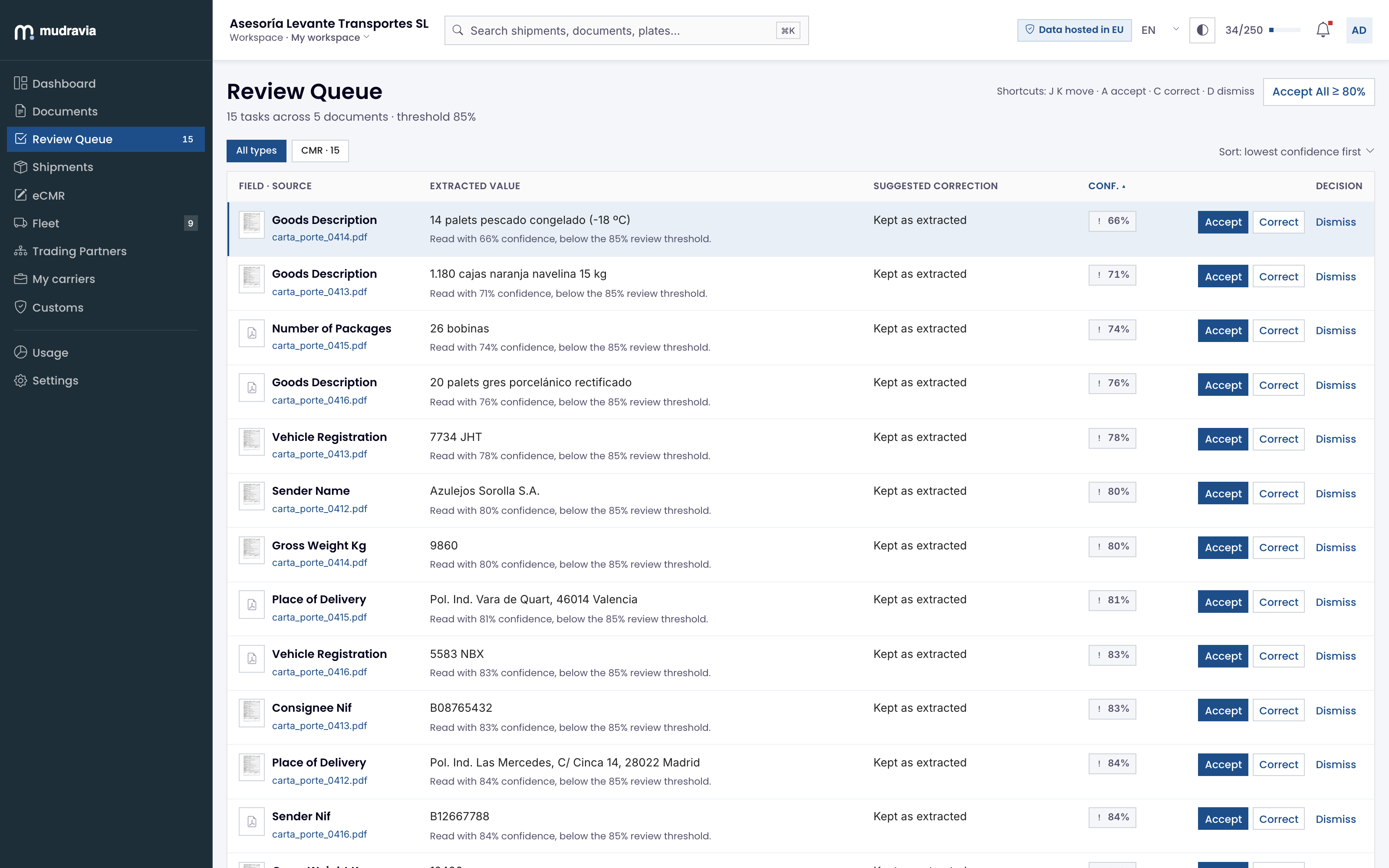
A review queue per client
Each client sits in its own workspace with its own audit trail. The queue shows only the fields that scored below the 85% confidence threshold, with the matching fragment of the carta de porte beside them, so the reviewer sees the source and decides in seconds. Corrections are recorded with who and when.
The DeCA reaches the driver with its QR
On approval the driver receives a link. The DeCA opens in the phone's browser as a native PDF carrying the credential-free QR an inspector scans at the roadside, and a printed copy bearing the QR works just as well. No app to install.
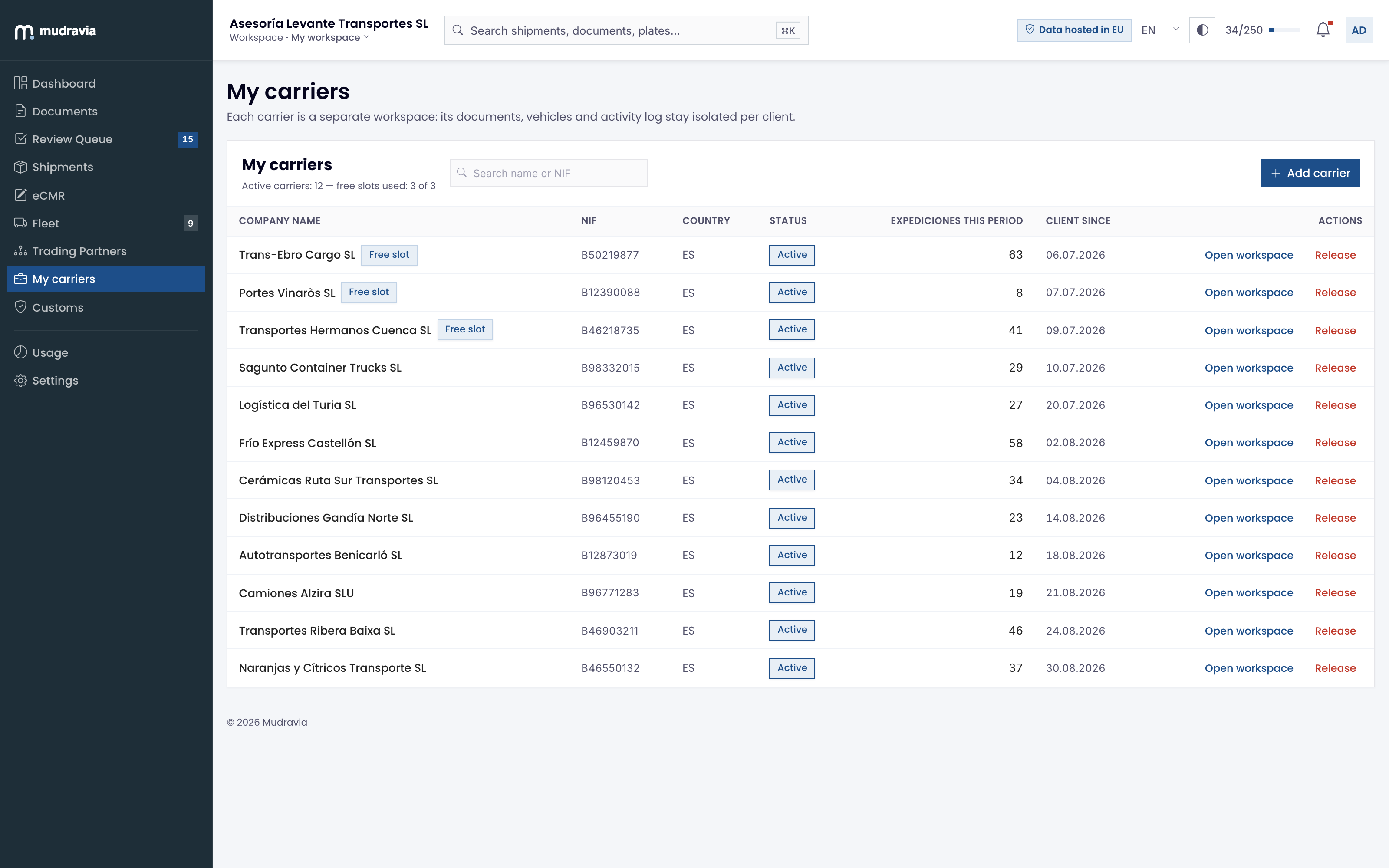
The whole client book on one screen
The portfolio view lists every client with today's expediciones, how many DeCAs are waiting for review and how many have been handed to drivers. The gestoría sees where the work is before a carrier calls.
The document can start as a photo
A driver with a paper carta de porte photographs it in the mobile app. Edge detection straightens the page, the upload lands in the client's queue, and the gestoría sees the fields before the truck leaves the yard. No scanner, no email round-trip.
API and MCP, for the systems already in place
Gestorías and carriers who already run a TMS or an ERP do not have to move work into another screen. The REST API creates a DeCA, an eFTI dataset or an eCMR from a document or a structured payload, and returns the artefact with its QR and audit reference. The same surface is exposed as an MCP server, so an AI assistant or agent inside your own stack can call the tools directly — with review and approval still landing in the console.
POST /v1/documents
  source: "camera" | "pdf" | "api"
  client_id: "gest-0412"

POST /v1/deca  → native PDF + QR
POST /v1/ecmr  → OLF eCMR record
POST /v1/efti → eFTI datasetcreate_decacreate_ecmrcreate_efti_datasetget_review_statusCreation is still review-gated: the tools return a document pending approval, never a filed one.
Why this is a capacity problem
Volume, not complexity.
A single DeCA is not hard. The problem is how many there are. A gestoría with 40 carriers in its book, each running around 30 expediciones a month, has to prepare roughly 1,200 DeCAs a month from 5 October. Typing them one by one does not fit in an office day; Mudravia turns each carta de porte into a DeCA that is ready to review instead of one that has to be keyed in.
Scope — the part most tools get wrong
Interior transport needs a DeCA. International carriage does not.
A run into or out of Spain under a CMR note is expressly out of scope. Spanish law sends international carriage to the documents of the applicable convention. Cabotage runs inside Spain do need one: cabotage is interior transport, so it is in scope, and from 5 October 2026 that document must be digital. Being established elsewhere changes nothing — a foreign carrier doing cabotage in Spain is treated exactly like a Spanish one.
Read the full DeCA guide →Interior transport inside Spain — including cabotage by carriers established elsewhere. Digital from 5 Oct 2026.
International carriage into or out of Spain. No DeCA — it travels on the consignment note of the applicable convention.
One engine · every document the run needs
The paperwork that used to mean a desk full of forms.
Mudravia reads one document and produces what the shipment needs — each validated against the rules that actually reject it, each yours to export, hand to a client, or send on.
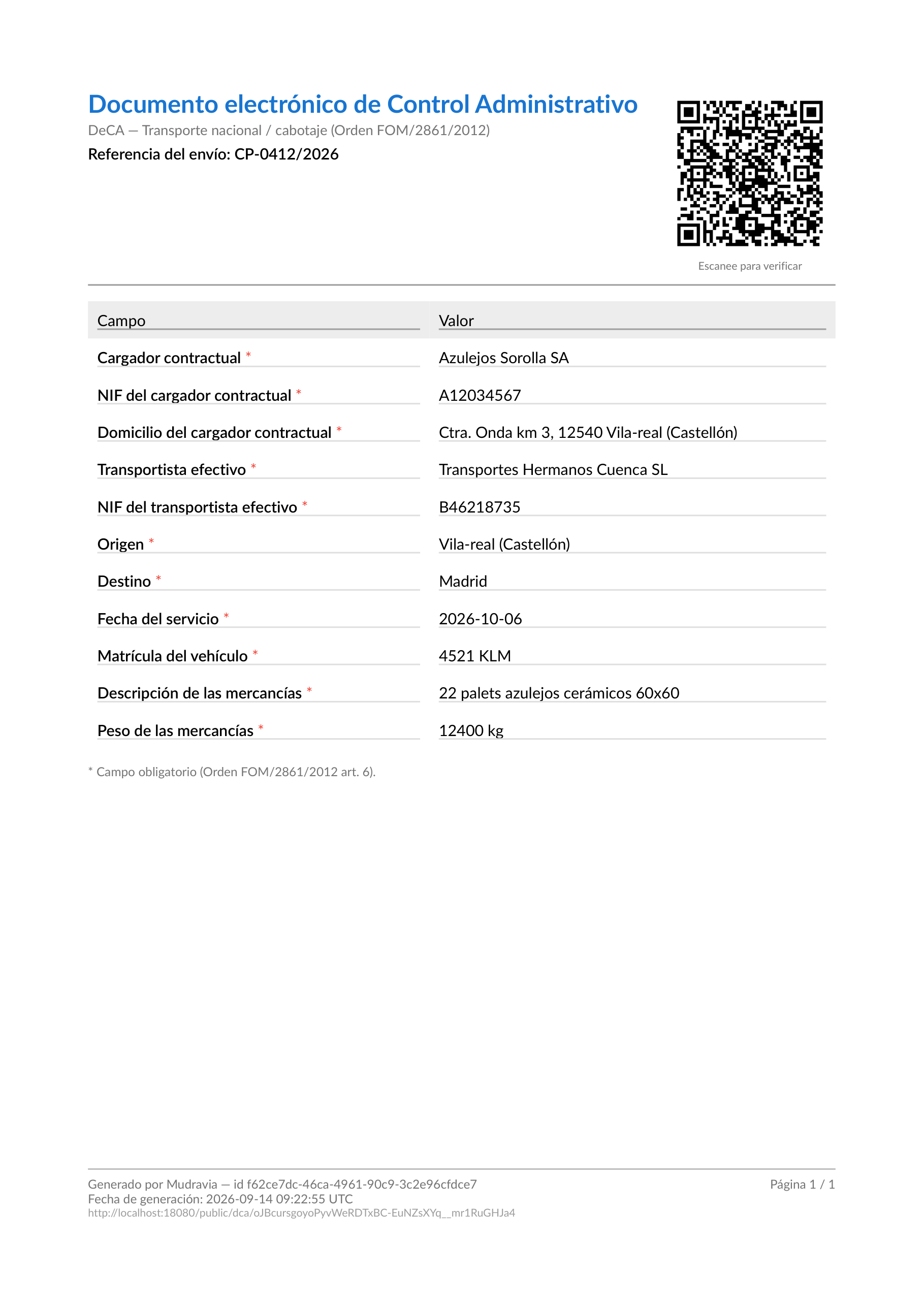
PDF nativo
Spanish DeCA
The Documento electrónico de Control Administrativo (DeCA) for road transport, generated as a native PDF carrying the credential-free QR an inspector scans at the roadside.
eCMR consignment note
A digital consignment note built on the Open Logistics Foundation eCMR data model — sealed at handover, timestamped, and shareable with the client who asked for proof.
ICS2 entry-summary pre-fill
The entry-summary dataset customs expects, prepared before the goods arrive. Every mandatory field we could not source is listed explicitly rather than guessed, so you know exactly what a real filing still needs.
The boundary
Mudravia prepares documents; it does not file them.
Mudravia prepares, validates and seals freight documents. It does not submit them to customs, to ICS2, or to a national eFTI platform on a carrier's behalf, and it is not a certified eFTI platform. The ICS2 output is an entry-summary pre-fill for your review and export. It does not act before any authority on your behalf and does not replace professional judgement.
«Mudravia prepara los documentos; no los presenta.»
- Reads the carta de porte and extracts the fields
- Routes low-confidence fields to your staff for review
- Generates the DeCA as a native PDF with its QR
- Seals the eCMR record; drafts the ICS2 pre-fill
- Delivers the DeCA to the driver's phone
- File anything with the transport administration
- Submit to customs or to ICS2
- Submit to a national eFTI platform
- Act before any authority on your behalf
- Replace professional judgement
Founding cohort · pricing published
Priced per managed carrier. No sales call to find out.
For the founding cohort: no base fee for the first six months, EUR 12–15 per month per managed carrier, and the first three clients free to test the flow on real cases. Agents set their own price to their clients.
Data & hosting
Compliance software you can hand your data to.
Platform data is hosted in the EU — database, documents, backups. Each client sits in its own space with its own audit trail, which you own and can export — for the authority, the client, or the carrier. Zero standing access to raw data; time-boxed, audited break-glass only.
Pilot cohort · ahead of 5 Oct 2026
Ready before the mandate, not after.
We're onboarding a first group of gestorías. Leave an email and we'll show you the flow on one of your clients' real cases in twenty minutes.